

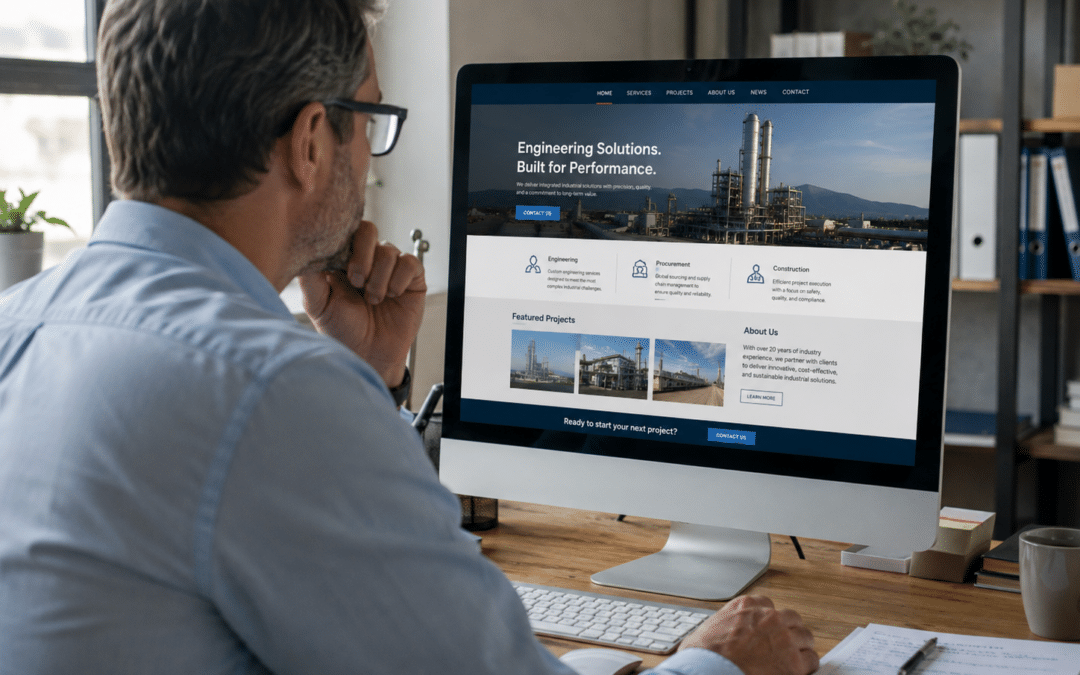
A B2B website should help potential clients quickly understand what your company does, who you work with, and what proves your capabilities. Generic phrases such as “quality,” “excellence,” or “integrated solutions” can support your message, but they should never replace a clear explanation of your services, experience, and the types of projects your company delivers.
Why Do So Many Business Websites Say a Lot but Explain Very Little?
Some companies have years of experience, skilled professionals, infrastructure, clients, and important projects behind them.
Yet when someone visits their website, they often find messages like:
- “We are leaders in our industry.”
- “We provide comprehensive solutions.”
- “We work with quality and commitment.”
- “We deliver innovative solutions.”
- “Excellence is our priority.”
None of these statements are necessarily wrong.
The problem is that hundreds of different companies could say exactly the same thing.
After reading them, a visitor may still not understand what the company actually does.
What Should Someone Understand When Visiting a B2B Website?
A business website should answer three basic questions as early as possible:
- What does this company do?
- Who does it work with?
- Why should I trust it?
These questions sound simple, but many websites fail to answer them clearly.
1. Clearly Explain What Your Company Does
Your main message does not need to explain every service you provide.
It simply needs to give the visitor enough context to understand the business.
For example:
Generic message:
“We provide comprehensive solutions with quality and innovation.”
Clearer message:
“We manufacture and install steel structures for industrial and mining projects.”
The second version immediately tells the visitor what the company does.
It is not trying to sound more impressive.
It is trying to be more useful.
2. Show Who You Work With
Most B2B companies are not trying to sell to everyone.
They usually specialize in specific industries, types of projects, or types of clients.
For example:
- mining;
- construction;
- manufacturing;
- energy;
- logistics;
- engineering;
- institutions;
- other service companies.
Showing this information helps a potential client quickly recognize whether your company has experience in a context similar to theirs.
It also gives your services more meaning.
For example, compare:
“We provide industrial maintenance services.”
with:
“We provide preventive and corrective maintenance for industrial facilities and mining operations.”
The second version gives the visitor a much clearer understanding of the company’s specialization.
3. Show Why Someone Should Trust Your Company
One of the biggest differences between generic communication and strong B2B communication is evidence.
Saying:
“We have extensive experience.”
is a claim.
Showing that experience gives the claim credibility.
Depending on the business, a website can include:
- completed projects;
- real photographs;
- professional team members;
- facilities;
- machinery and equipment;
- work processes;
- industries served;
- methodology;
- company experience;
- actual certifications;
- specific case studies;
- clients, when permission has been given to mention them.
The information should always be accurate, relevant, and verifiable.
The objective is not to overload the website with information.
It is to show the elements that help a potential client evaluate your company.
Why Is This Especially Important for B2B Companies?
In B2B, someone may visit your website at many different stages of the buying process.
For example, after:
- receiving a recommendation;
- meeting someone from your company;
- receiving a company presentation;
- searching for suppliers on Google;
- discovering the company on LinkedIn;
- seeing an advertisement;
- attending a meeting;
- starting to compare different suppliers.
The website can become an important validation tool.
The person may already know your company name and simply want to understand who is behind it.
At that point, vague communication can create more questions than answers.
Your Potential Client Does Not Know Everything You Know About Your Company
This is an important distinction.
When you work inside a company every day, many things feel obvious.
Your team knows which projects have been completed.
They know the professionals involved.
They know the infrastructure.
They know the company’s history.
They understand its technical capabilities.
But someone visiting the website for the first time does not have that context.
They can only evaluate what your company chooses to show them.
That is why digital communication should translate internal knowledge into information that an external audience can easily understand.
What Information Should a B2B Website Include?
Not every company needs exactly the same website structure, but some elements are generally important.
A Clear Value Proposition
Visitors should quickly understand what the company does and the context in which it operates.
Services
Each service should be explained well enough for a potential client to understand what it involves and what type of need it addresses.
Industries
Showing the markets or industries you serve helps give your experience context.
Projects
Projects demonstrate the type of work your company is capable of delivering.
Company Information
Your company section can explain your history, team, infrastructure, processes, and capabilities.
Evidence
Include relevant information that supports the claims you make throughout the website.
Contact Information
Someone who is interested in working with your company should clearly understand what to do next.
Does a Professional Website Need a Lot of Text?
Not necessarily.
A website can contain a large amount of text and still be confusing.
It can also look visually impressive while failing to explain the company properly.
The goal is not to maximize the number of words.
The goal is to present the right information at the right moment.
A good website structure should naturally guide visitors through a sequence of questions:
What does this company do?
Then:
Does it work with companies like mine?
Then:
Does it have the experience and capability to do the job?
And finally:
How can I contact them?
Good Design Cannot Replace a Clear Message
Design and content have different roles.
Design helps:
- organize information;
- create hierarchy;
- improve readability;
- simplify navigation;
- support a professional perception.
Content explains:
- what the company does;
- what it offers;
- who it serves;
- what experience it has;
- why it may be the right choice.
A strong B2B website needs both.
Excellent visual design cannot automatically fix an unclear value proposition.
How Can You Tell If Your Website Copy Is Too Generic?
There is a simple test.
Copy the first paragraph from your homepage.
Remove your company name.
Now ask yourself:
Could a completely different company use exactly the same paragraph?
If the answer is yes, your message probably needs to be more specific.
You can also ask someone who does not know your company to look at your website for a few seconds.
Then ask:
- What does this company do?
- Who does it work with?
- What makes you believe it has experience?
- What would you do if you wanted to contact them?
Their answers can reveal communication problems that are difficult to notice from inside the business.
Example: From Generic Corporate Language to a Clear Message
Imagine a company that manufactures and installs steel structures.
It could introduce itself like this:
“We are leaders in comprehensive solutions, committed to quality, excellence, and innovation.”
The statement sounds professional.
But it does not explain the company’s activity.
An alternative could be:
“We manufacture and install steel structures for industrial and mining projects.”
Now the visitor immediately understands:
- what the company does;
- which industries it serves;
- what type of need it can address.
From there, the website can demonstrate its capabilities through projects, team members, facilities, processes, and real experience.
The first message provides direction.
The evidence builds trust.
Should Companies Stop Talking About Quality, Commitment, or Innovation?
No.
These concepts can still be an important part of a company’s identity.
The issue is using them as a substitute for concrete information.
If a company talks about quality, it should explain how quality is managed.
If it talks about experience, it should provide evidence.
If it talks about specialization, it should explain what that specialization involves.
If it talks about capability, visitors should be able to see what supports that claim.
Corporate language becomes more meaningful when it is backed by facts.
Your Website Should Reflect the Company You Are Today
Many B2B companies improve their operational capabilities long before they update their digital presence.
They hire more people.
They expand their services.
They invest in equipment.
They take on larger projects.
They gain more experience.
But their website continues to communicate the company they were several years ago.
That creates a gap between the real business and the way the market perceives it online.
Improving a website is not only about changing colors, images, or technology.
It also means reviewing the story the company is telling about itself.
Your digital presence should help an external visitor understand the company that actually exists today.
A strong B2B website does not need to make your company look bigger than it is.
It needs to prevent your company from looking smaller than it really is.
Frequently Asked Questions
What should the main message on a B2B website say?
It should clearly explain what the company does, what types of clients or industries it serves, and its main area of expertise.
Is it wrong to use phrases like “quality and commitment”?
No. The problem occurs when these phrases are too generic and replace specific information about services, experience, and capabilities.
How can a business website build trust?
Trust can be supported by showing real projects, team members, work processes, facilities, experience, industries served, actual certifications, and clear contact information.
Should an industrial company show completed projects on its website?
When possible and when the company has permission to do so, completed projects can help demonstrate the type of work the company performs and provide useful context for its experience.
How do I know if my website copy is too generic?
Remove your company name from the opening paragraph and ask whether a company in a completely different industry could use the same text. If the answer is yes, the message probably needs to be more specific.
Does a B2B website need to be highly technical?
Not necessarily. It should provide the technical information potential clients need while keeping the overall structure clear and understandable. More detailed technical information can be placed on dedicated service or project pages.
What is more important: website design or content?
Both are important and serve different purposes. Design organizes the experience and supports professional perception, while content explains the company’s services, expertise, and capabilities.
What should I review first when improving my company website?
Start with the main homepage message, service descriptions, industries served, evidence of experience, and the clarity of your contact options.
SEO Configuration
SEO Title: How to Clearly Communicate Your B2B Company Online
Meta Description: Learn how to explain what your B2B company does, avoid generic website messaging, and clearly communicate your services, experience, and capabilities.
Recommended Slug: communicate-b2b-company-website
Primary Keyword: how to communicate your company on a B2B website
Secondary Keywords: B2B website, B2B website copy, business website content, B2B value proposition, industrial website design, B2B communication, company website messaging, build trust online, how to present a company online
Search Intent: Informational + commercial