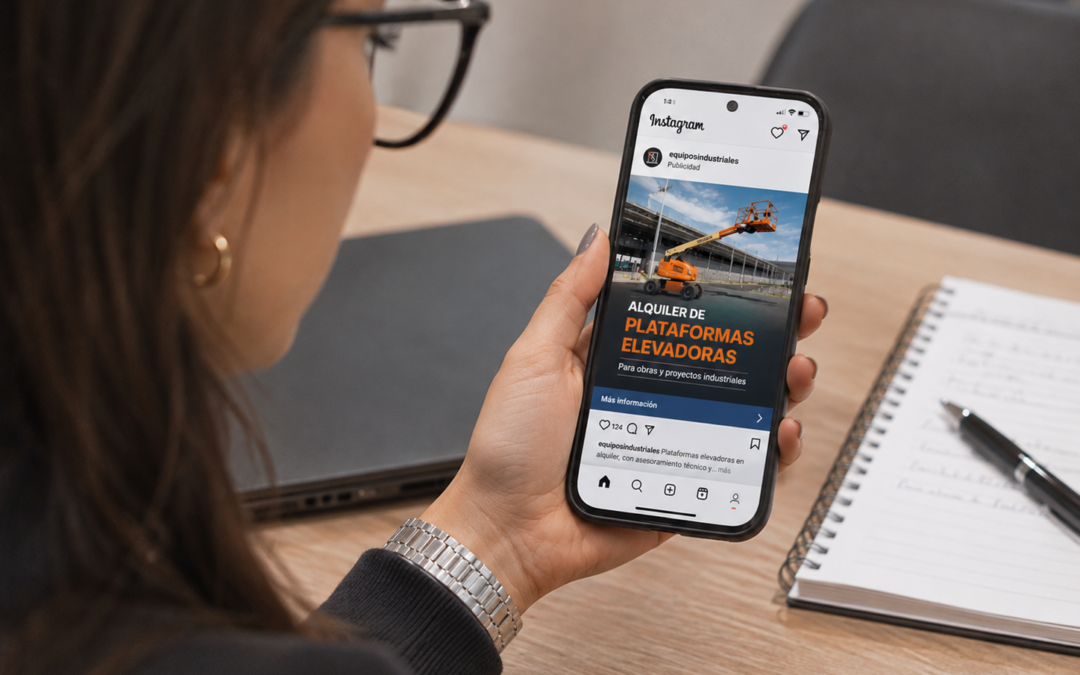
The post-click experience is what happens after someone interacts with a digital advertisement. It includes the landing page, the information presented, the contact process, and the next action available to the visitor. For B2B companies, a consistent post-click journey helps buyers find what they expected, understand the offer, and move towards a relevant commercial conversation.
A Click Creates an Expectation
Imagine a company advertising industrial equipment rental to contractors and construction firms.
The advertisement features a specific type of equipment and explains the service.
A project manager sees the ad and clicks.
Instead of arriving at equipment information, the visitor lands on a general corporate homepage.
There is a company history, a mission statement, several service categories, and a collection of project photographs.
Equipment rental is somewhere on the site, but finding it requires additional effort.
The advertisement successfully captured attention.
The next step made the buyer work harder than necessary.
That distinction matters because advertising performance and the experience following the click are closely connected.
What Is Message Match in Digital Advertising?
Message match describes the consistency between an advertisement and the destination it leads to.
A buyer clicking an ad about industrial maintenance expects information related to industrial maintenance.
Someone responding to an invitation to request a quotation expects a clear way to submit that request.
When the landing page continues the same subject, the buyer can move forward with less confusion.
Message match does not require every sentence to be identical.
The destination should simply preserve the intent and context of the original message.
A Practical Example
Consider an advertisement for on-site mechanical maintenance.
A relevant landing page might explain the types of equipment supported, the scope of the service, available technical resources, and how to request an initial assessment.
That provides continuity.
By contrast, a broad homepage listing engineering, fabrication, logistics, maintenance, and other services leaves the visitor searching for the information that originally attracted them.
The difference can be significant even when both pages look equally professional.
1. The Landing Page Should Reflect the Advertised Service
A landing page is the destination that receives visitors from an advertisement or campaign.
It may be a dedicated campaign page or an existing service page.
For B2B companies, the right choice depends on the offer and the next step the buyer is expected to take.
Creating a new landing page for every advertisement is not always necessary.
A well-structured service page can already provide the right experience.
What Should Buyers Find There?
Useful information may include:
- a clear description of the advertised service;
- the types of projects or customers it serves;
- relevant capabilities and operating scope;
- representative evidence, when available;
- answers to likely questions;
- a visible, appropriate contact action.
A company renting equipment may need to explain capacity, availability considerations, and operating coverage.
An engineering consultancy may need to present technical disciplines, project methodology, and the information required for an initial assessment.
The landing page should reflect the buying context.
2. Sending Every Ad to the Homepage Can Create Friction
A corporate homepage serves an important purpose.
It introduces the company, communicates its main capabilities, and provides a starting point for exploration.
However, it may not be the most relevant destination for a highly specific advertisement.
Imagine a business with separate campaigns for maintenance, fabrication, mechanical installation, and equipment rental.
If every campaign leads to the same general page, visitors must identify the correct service again.
The advertisement has already identified their interest.
The destination should build on that information.
When a Homepage Can Still Make Sense
Brand-awareness campaigns or broader institutional messages may reasonably lead to the homepage.
A service-specific campaign often benefits from a more focused destination.
The important decision is not whether every campaign needs a standalone landing page.
It is whether the selected destination makes sense for the visitor’s intention.
3. Messaging Apps Are Part of the Post-Click Journey
Some B2B companies use advertising that leads directly to WhatsApp or another messaging platform.
This can make initial contact easier, particularly when buyers need personalised information.
However, the interaction can lose context immediately.
Imagine an advertisement offering forklift rental for industrial projects.
The buyer clicks to start a conversation.
The message simply says:
“Hello.”
The sales representative may have no indication of which service interested the person.
Both sides now need to reconstruct the conversation.
Preserve Context Where Possible
When campaign settings allow it, a relevant suggested opening message can make the interaction more useful.
For example:
“Hello, I would like information about forklift rental for an industrial project.”
The sales team should also know which services are being promoted and what information is needed to move enquiries forward.
An opening message cannot replace a good sales conversation.
It can help that conversation begin in the right place.
Make the First Human Response Relevant
If a buyer asks about equipment rental, the response should acknowledge that requirement.
The company might ask about the equipment type, location, expected rental period, and operating conditions.
Sending a generic company presentation before addressing the enquiry creates unnecessary distance between the buyer’s need and the seller’s response.
4. Remove Unnecessary Steps From the Enquiry Process
Complex B2B services sometimes require detailed information before a proposal can be prepared.
An engineering project may involve drawings, technical specifications, locations, or preliminary scope documents.
That does not necessarily mean every detail should be requested during the first interaction.
A long form can become a barrier when the buyer is still exploring suppliers.
On the other hand, a form asking only for a name and email may leave the sales team with too little context.
The appropriate balance depends on the stage of the buyer’s journey.
Initial Enquiry Versus Technical Assessment
An initial form might ask for the company, contact details, general service requirement, and project location.
Additional technical information can follow once the enquiry has been reviewed.
This approach allows the first conversation to begin without requiring the prospect to complete a detailed procurement process prematurely.
5. Test the Mobile Experience
A landing page may look excellent on a large desktop monitor while being difficult to use on a phone.
Potential problems include an awkward navigation menu, buttons that are difficult to tap, a form that requires excessive scrolling, or important information buried below unrelated content.
Slow page loading can create another obstacle.
These issues matter because they affect the visitor before the sales team has any opportunity to respond.
Review the Journey as a New Visitor
Open the actual advertisement on a mobile device.
Follow the link.
Try to locate the service information.
Attempt the enquiry.
Check whether the form works correctly and whether the page clearly explains the next step.
The test should be conducted without relying on prior knowledge of the company website.
An internal team may know exactly where everything is located. A first-time buyer does not.
6. Give the Buyer One Clear Next Step
Some landing pages contain plenty of useful information but leave the next action unclear.
There may be project examples, technical descriptions, photographs, and service details.
However, the contact option is difficult to find.
A strong post-click experience should make the next commercial step understandable.
That does not mean filling the page with competing buttons.
It means choosing an action that fits the buyer’s intent.
For example:
Request a quotation: appropriate when the buyer already understands the requirement.
Check availability: useful when equipment, resources, or dates influence the decision.
Speak with a specialist: relevant for complex technical services.
Request information: suitable when the buyer needs an initial conversation before defining a project.
The action should continue the promise made by the advertisement.
7. Measure What Happens After the Click
Advertising platforms provide useful information about clicks and other interactions.
Website analytics and properly configured conversion tracking can add another layer.
However, businesses need to define what each event actually represents.
A click on a WhatsApp button is not necessarily a completed conversation.
A completed contact form may not represent a qualified commercial opportunity.
Keeping these distinctions clear makes performance reporting more useful.
Events Worth Reviewing
Depending on the website and campaign, a business might track:
- landing page visits;
- relevant service page interactions;
- contact button clicks;
- submitted enquiry forms;
- initiated messaging conversations, where measurable;
- defined conversion events.
Tracking requires proper implementation and testing.
It is also important to handle data appropriately and comply with applicable privacy and consent requirements.
The objective is to understand where prospects encounter obstacles rather than simply collect more metrics.
A B2B Example: One Ad, Two Different Experiences
Imagine an industrial contractor advertising mechanical installation services.
Experience A: A Generic Journey
The advertisement mentions installation services for industrial facilities.
The buyer clicks and reaches the corporate homepage.
The first screen contains general language about experience and quality.
Several other services appear before installation.
After navigating multiple sections, the buyer finds a general contact form.
The prospect must do much of the work required to connect the advertisement with the company’s actual offer.
Experience B: A Connected Journey
The same advertisement leads to a focused mechanical installation service page.
The page explains the scope, the types of projects the company can support, relevant resources, and representative experience.
A clear contact action allows the buyer to describe the project and request an initial discussion.
The second experience is easier to follow.
It does not guarantee a sale, and it does not remove the need for qualification or a competitive offer.
It simply helps buyers continue from the point where the advertisement captured their interest.
How to Audit Your Post-Click Experience
A useful audit starts with a single live advertisement.
Read the message carefully.
Identify the expectation it creates.
Then follow the journey exactly as a prospective customer would.
Review the destination, the information provided, the contact action, and the first interaction that follows.
Ask whether the experience continues naturally or requires the buyer to start over.
Repeat this process for campaigns promoting different services.
You may discover that some advertisements need different landing pages or different enquiry flows.
You may also find that relatively small adjustments can remove avoidable obstacles.
Marketing, Web, and Sales Need to Share the Same Context
In many companies, advertising is managed by one team, the website by another, and enquiries by the sales department.
Each part may be reasonably well managed.
The problem is that the buyer experiences them as a single journey.
If the advertisement promotes one service, the website focuses on something else, and the salesperson has no idea where the enquiry originated, the overall experience becomes fragmented.
Improving post-click performance requires those parts to share a common understanding of the offer.
What does the ad promise?
Where does it lead?
What action should the buyer take?
What should the sales team know when the enquiry arrives?
Those decisions connect advertising activity with a practical commercial process.
Your Ad Does Not End When Someone Clicks
A click is an important signal of interest, but it is only the beginning of the next stage.
The destination needs to help the visitor find what they were looking for, assess the offer, and take an appropriate next step.
For B2B companies, the opportunity often lies in improving that continuity rather than changing the advertisement immediately.
Before increasing the advertising budget, it is worth asking:
Does the experience after the click continue the conversation your advertisement started?
Frequently Asked Questions
What is a post-click experience?
It is the experience a person has after interacting with a digital advertisement, including the landing page, navigation, information, contact process, and next action.
Why do my ads get clicks but few enquiries?
Possible causes include poor message match, an unclear landing page, slow loading, confusing navigation, inconvenient forms, or a weak call to action. Traffic relevance should also be reviewed.
Should ads link to a homepage or a landing page?
The destination should match the advertising objective. Service-specific ads often benefit from focused service pages, while broader brand campaigns may have different requirements.
How can a company improve WhatsApp enquiries from ads?
Provide context relevant to the advertised service, use appropriate suggested opening messages where supported, and ensure the sales team is prepared to respond to that specific enquiry.
What should a B2B landing page include?
Clear service information, relevant capabilities, supporting evidence where available, answers to important buyer questions, and a contact action appropriate to the sales process.
How do you measure post-click performance?
Companies can review landing page visits, relevant interactions, submitted enquiries, contact events, and downstream outcomes when tracking is configured correctly.
What is message match?
Message match is the consistency between an advertisement’s promise and the information or experience provided at its destination.
Does improving the landing page guarantee more sales?
No. It can reduce friction and help buyers continue, but commercial results also depend on the offer, target market, qualification, sales conversations, and follow-up.